The History of the Stroopwafel
Born in nineteenth-century Gouda, the stroopwafel went from a humble poor man's cookie to a global icon. Here is its story, myths and all.
By Daniel MellicovskyBaker and owner, Melly's Stroopwafels
Nearly everyone in the Netherlands recognises the stroopwafel, and its popularity reaches far beyond the Dutch border. Yet its beginnings are less well known, and even historians cannot agree on the exact year it was first baked. Here is what the records do, and do not, tell us. If the treat is new to you, start with what a stroopwafel is.
Born in Gouda in the nineteenth century
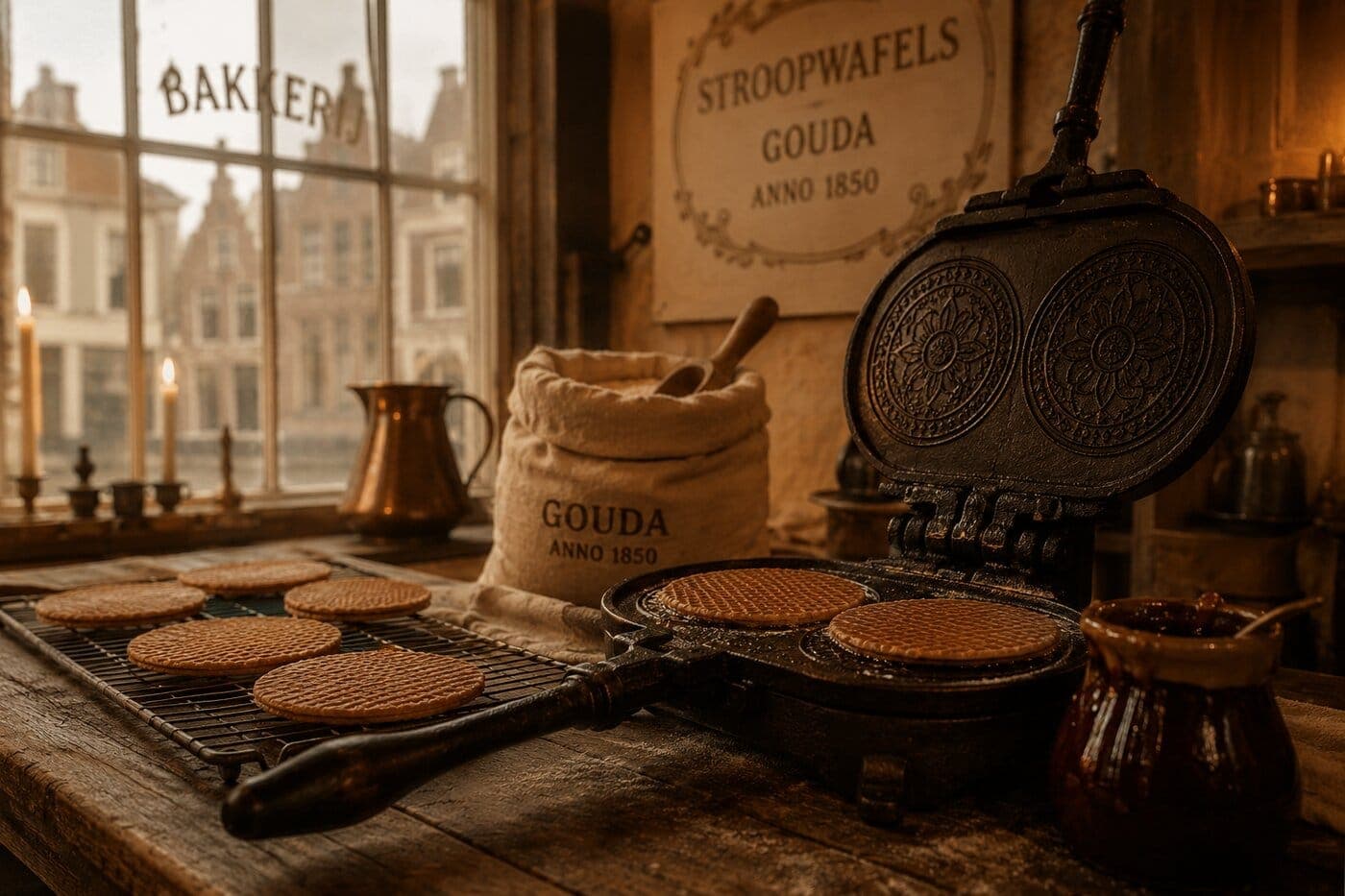
The stroopwafel was first made in the city of Gouda, in South Holland, during the nineteenth century. Several sources name the Kamphuisen bakery, set up in Gouda in the early 1800s, as the first to bake them, though no one knows precisely when it started. The historian De Korte, who published a history of Gouda's stroopwafel bakers in 2012, argues that a gas flame is needed to bake them properly. Since Gouda's syrup factory opened in 1837 and its first gasworks in 1853, he places the earliest stroopwafels a few years after 1853.
Who baked the first one?
The honour is disputed. In 1864 a Gouda baker named Adriaan de Groot is recorded as the first to use a stroopwafel iron, and his business was later continued by a baker called Wever, who took over the recipe. Others believe Kamphuisen may have been making syrup waffles even earlier. The truth is hard to pin down, and there is a reason the records are so thin. The guilds that once registered such trades had been abolished, the bakers were small independent businesses with no legal disputes to put on file, and Gouda had no local newspaper at the time in which a baker might have advertised.
The ‘poor man's cookie’
Originally the treat was called a siroopwafel, or syrup waffle. The popular story is that bakers made them from old cookie scraps, leftover dough and syrup, which kept them cheap, so that in the nineteenth century they were sometimes called the poor man's cookie. It is a good story, but not everyone accepts it. De Korte points out that he has never found cookie scraps listed in any old recipe, so the leftovers version may be more legend than fact. What is clear is that they were inexpensive and quickly became a favourite.
From a Gouda speciality to a global treat
For decades stroopwafels were a Gouda speciality, measuring about ten centimetres across. From 1870 they began to be made elsewhere too. The city was once full of them: around 1960 Gouda still had seventeen syrup waffle factories, but by 2000 only four remained. Today they range from five to twenty-five centimetres in diameter and are enjoyed all over the world. You can read more about how they come together in our guide to how stroopwafels are made.
Gouda variants
Over the twentieth century Gouda produced its own variations. The Punselie waffle is a small version named after the Gouda baker Bertus Punselie, who began making it in 1945; the Punselie firm finally closed its doors in 2024. The Adéko waffle, created by the Gouda pastry chef Abraham de Korte in 1939, took its name from his initials and was baked in an oven rather than on a waffle iron to save on labour.
The warmest, freshest version is still best tasted in person, so come and find us in Amsterdam or pick your favourite flavour. Better still, make your own at our workshop.
Taste it warm in Amsterdam
Order fresh stroopwafels to your door, or learn to make your own at a Melly's workshop in the heart of the city.