How to Pronounce Stroopwafel, and What the Word Means
Three syllables, the stress on the first, and a 'w' that is almost a 'v'. Here is how the Dutch say it.
Von Daniel MellicovskyBaker and owner, Melly's Stroopwafels
Said the Dutch way, stroopwafel comes out as STROPE-vah-fuhl: three syllables, with the stress on the first one. In phonetic notation that is /ˈstroːpˌʋaːfəl/. Most English speakers say something closer to “stroop-waffle”, which gets you a stroopwafel at any market stall in Amsterdam, but also tells everyone you arrived this week. Here is the word sound by sound, and where it comes from.
Stroopwafel, sound by sound
- Stroop. The double o in Dutch is a long “o”, close to the vowel in the English “rope”. It is not the “oo” of “loop”: Dutch spells that sound “oe”. So the first syllable sounds like “strope”, and it carries the stress.
- Wa. The Dutch w sits between an English v and w. Your lower lip touches your upper teeth lightly, without rounding the lips the way English does for “water”. If in doubt, lean towards v. The a is long, like the a in “father”: “vah”.
- Fel. Short and unstressed, like the end of “careful”: “fuhl”.
Put together: STROPE-vah-fuhl. The r can be rolled, tapped or said from the back of the throat. Dutch speakers use all three, so any of them is fine.
The three mistakes English speakers make
- Stroop as in troop. The most common one. The Dutch oo is a long o, so it rhymes with rope, not with loop.
- Waffle instead of wafel. The second half is the Dutch word wafel, with a long a and a soft w: “vah-fuhl”, not the English “waffle”.
- Stress in the middle. Saying “stroop-WAH-fel”. In Dutch compound words the stress stays on the first part.
None of these will stop anyone from selling you one. But get the first syllable right and you will sound a lot less like a tourist.
What the word means
Stroopwafel is a compound of two Dutch words: stroop, syrup, and wafel, waffle. Literally a syrup waffle, which is exactly what it is: two thin, crisp waffles pressed around a layer of warm caramel syrup. In Dutch, stroop covers several thick syrups, from the dark appelstroop spread on bread to the syrup poured over pancakes. The stroop inside a stroopwafel is a caramel of syrup, brown sugar, butter and cinnamon, and you can see it being made in our traditional stroopwafel recipe.
The word, and the waffle, come from Gouda, where bakers started making them around the end of the 18th century. The history of the stroopwafel has the rest of the story.
The plural, and how to order one
The plural is stroopwafels, with an s, in Dutch and in English. If you want to order in Dutch, it is “een stroopwafel, alsjeblieft”, roughly “un STROPE-vah-fuhl, ahl-shuh-BLEEFT”. “Dank je wel” (“DAHNK yuh vel”) is thank you.
Where to practise
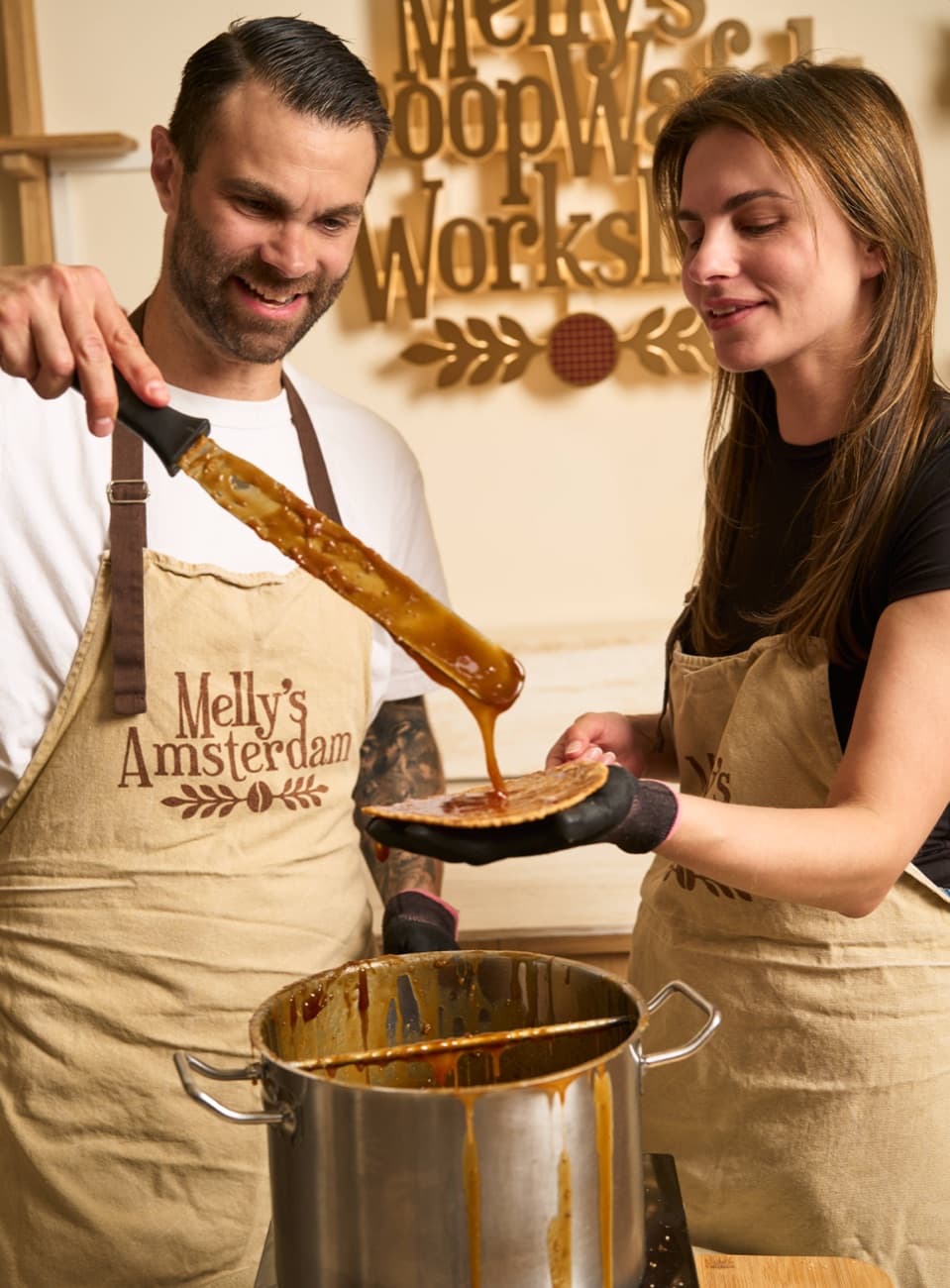
The best place to practise is somewhere that will hand you a warm one in return. At our shop in Amsterdam we press and fill fresh stroopwafels on the iron throughout the day, and in the stroopwafel workshop you press your own and fill it with warm caramel, saying the word a few dozen times before you leave. If you are not in Amsterdam, the stroopwafel pack ships across the Netherlands, Europe, the UK and the US.
Probier es warm in Amsterdam
Bestell dir frische Stroopwafels direkt nach Hause oder lerne bei einem Melly’s-Workshop im Herzen der Stadt, wie man sie selbst backt.